A Roadmap for
Digital Self-Determination in Data Spaces
Embedding Digital Self-Determination into the Governance of Trustworthy Data Spaces in Switzerland

Switzerland has set ambitious goals to expand digital public services, data-driven innovation, and responsible AI. Data spaces play a critical role in enabling it to pursue these goals by facilitating secure data sharing across sectors. However, data spaces require governance models that go beyond technical infrastructure. They require arrangements that can support sustained data reuse while maintaining trust and institutional legitimacy. While existing governance approaches (those built around individual consent) offer some utility, they are increasingly strained in contexts where data is reused across institutions, for various pruposes, where automated systems mediate access, analysis, and decision-making.
Digital Self-Determination is one important response to this new data ecosystem. Digital self-determination reframes data governance around ongoing agency rather than one-time consent, emphasizing transparency, meaningful choice, institutional accountability, and mechanisms for oversight across the full data lifecycle. Within the Swiss context, digital self-determination offers a foundation for reconciling data reuse with public expectation for autonomy and data protection.
Our report, “A Roadmap for Digital Self-Determination in Data Spaces: Embedding Digital Self-Determination into the Governance of Trustworthy Data Spaces in Switzerland” (July 2026) provides an architecture for operationalizing digital self-determination, with a particular focus on data spaces. It is intended for data space architect, governance authorities, and organizations responsible for designing and operating data sharing infrastructures.
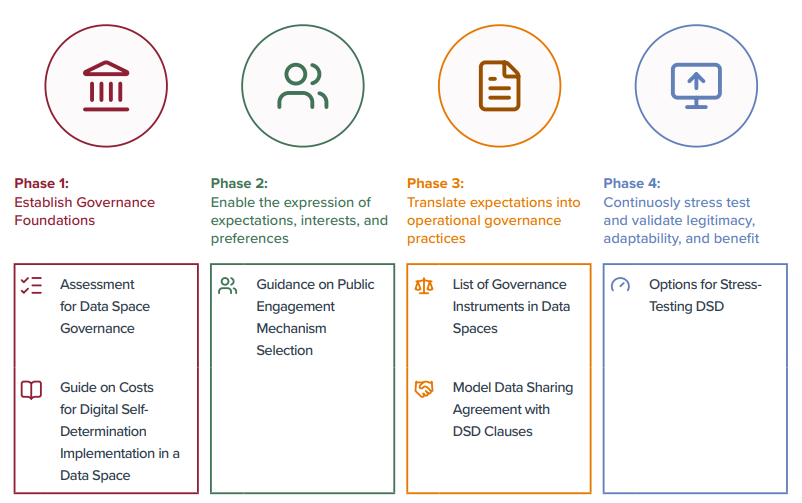
Built Around Four Iterative Phases
To implement digital self-determination, this report outlines four iterative phases of work. This starts with the most basic phase of establishing governance, with each successive phase building on that with additional mechanisms that incorporate digital self-determination into data activities.
By breaking this work down, we offer a means of helping practitioners operating at any phase in a data project.


Tools for Practitioners
In addition to these chapters, the report also includes a variety of tools that can guide practitioners as they try to integrate digital self-determination into data governance, tailored to the institutional realities of the Swiss data ecosystem. Links to each can be found below.
Assessment for Data Space Governance: This assessment has been developed as a practical tool to support the design of governance arrangements for data spaces. It is structured around four interconnected pillars of Purpose; Principles; Processes; and Practices & Policies.
Guidance on Costs for Digital SelfDetermination Implementation in a Data Space: This guidance explains how to scope, structure, and govern the costs required to implement Digital Self-Determination in a data space.
Guidance on Public Engagement Mechanism Selection: This tool provides information on each of the engagement types and several examples of the forms that outreach to communities to achieve digital self-determination can take.
List of Governance Instruments in Data Spaces: This tool provides an overview of the governance instruments that are commonly used to design, operate, and oversee data spaces.
Model Swiss Data Sharing Agreement with Digital Self-Determination Clauses: This tool reproduces an existing IPI Subscription Agreement for Access to Technical Data (Unilateral) and illustrates how considerations related to Digital Self-Determination can be reflected within an established contractual framework.
Options for Stress Testing Digital Self-Determination: This tool provides a set of stress testing and evaluation methods that data space operators can use to assess whether Digital Self-Determination is being upheld in practice over time.
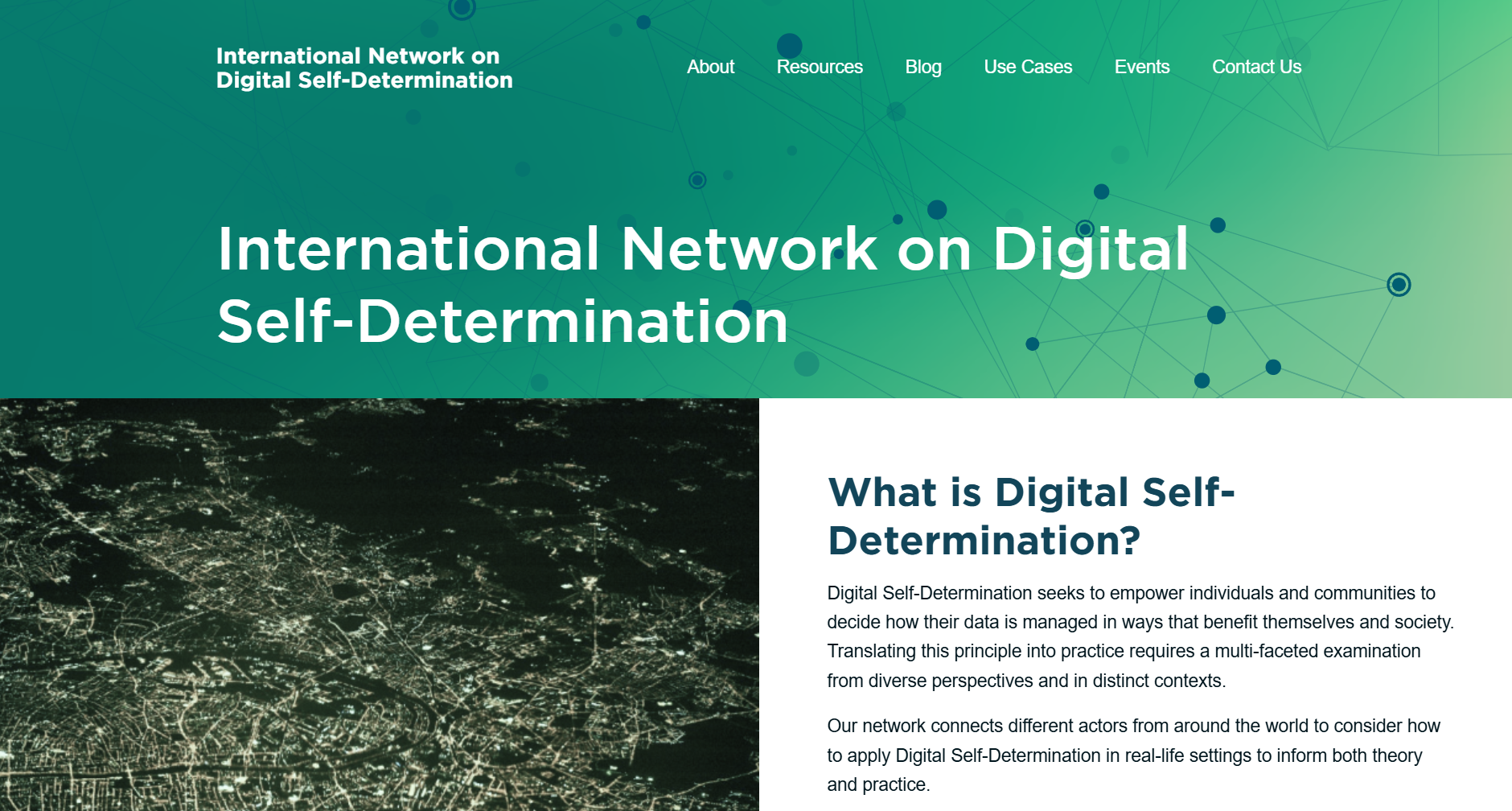
Make sure to also check out our International Network on Digital Self-Determination.
Our network connects different actors from around the world to consider how to apply Digital Self-Determination in real-life settings to inform both theory and practice.
It includes resources, blogs, example use cases, and details on major events related to digital self-determination.
If you have any questions or feedback or would like to share how this framework helped you, please contact us at datastewards@thegovlab.org.
The Open Data Policy Lab
The Open Data Policy Lab is a resource hub supporting decision-makers at the local, state and national levels as they work toward accelerating the responsible reuse and sharing of open data for the benefit of society and the equitable spread of economic opportunity.
The GovLab
The Governance Lab (GovLab), based at NYU’s Tandon School of Engineering, seeks to improve people’s lives by changing how we govern. We believe that increased availability and use of data and new ways to leverage the capacity, intelligence, and expertise of people can improve the way we make decisions and solve public problems.
Switzerland’s Federal Department of Foreign Affairs
The FDFA safeguards Switzerland's foreign policy interests. It maintains relations with other states and international organisations such as the EU and UN, and provides services for Swiss citizens abroad. It is also responsible for Switzerland's development cooperation and humanitarian aid. Switzerland maintains a global presence through its approximately 170 representations.